Material for editors, podcasts and talks
Everything on this page is cleared for use — no request needed, no embargo. What you will not find is a client list: this offering has no customers yet. The evidence is therefore not a track record but an open method, an archive of worked-through sample analyses and software you can operate yourself in five minutes.
Boilerplate in three lengths
Usable verbatim. Cut rather than rewrite — the qualifications in the text are the reason the sentences run long.
Flowrefy measures business processes in mid-sized companies: the workflow is rebuilt as a model, simulated hundreds of times, and the most expensive step is quantified in euros per year — as a range.
Flowrefy measures business processes in mid-sized companies before money goes into them. The workflow is rebuilt as a model, simulated hundreds of times under load, and the step that actually blocks is quantified in euros per year — as a range, not a point estimate. The brand name is the method: FLOW measures, REFY refines, eight steps. If the measurement finds no worthwhile lever, the answer is a refusal rather than an offer. Flowrefy is a brand of Balane GmbH, Munich.
Flowrefy measures business processes in mid-sized companies before software is bought against them. Instead of estimating an average, the workflow is rebuilt as a model and simulated hundreds of times under load; the result names the step that actually blocks and quantifies it in euros per year — always as a P10 to P90 range. The brand name is the method: FLOW measures (Find, Lay bare, Observe, Weigh), REFY refines (Reduce, Enable, Fit, Yield). Four calculators on flowrefy.com are free and need no sign-up; the simulation itself runs in the desktop application FlowVisual. Worked-through sample analyses are published with their arithmetic and their limits, including ones that advise against buying. Flowrefy and FlowVisual are brands of Balane GmbH in Munich.
“Flowrefy” — one word, capital F, no space and no hyphen. The method itself in capitals: FLOWREFY, because the name is the acronym (Find, Lay bare, Observe, Weigh, Reduce, Enable, Fit, Yield). The software is “FlowVisual”, capital F and capital V. Both come from “Balane GmbH”; “Balane” on its own is fine unless the context is legal.
Mid-sized companies buy software against problems they never measured.
The usual route: a task takes too long, management estimates an average, a tool gets bought. If the bottleneck was somewhere else, the money is gone and the queue remains — now with licence fees attached.
The reason is arithmetic, not cultural. A process is not a sum: lead time comes out of queues, variation and capacity limits. Above roughly 80 per cent utilisation, waiting time grows disproportionately; at 100 per cent it has no upper bound at all. An average cannot represent that effect. A simulation can — and that is exactly the step missing from most investment decisions.
From this follows the practice that is more interesting for a story than the offering itself: the analyses get published — with model, assumptions, arithmetic and a mandatory section on the limits of that particular analysis. One of the sample analyses explicitly recommends not buying. Client references and results from other people's mandates do not appear, because they prove nothing about the reader's own process.
The details you would otherwise have to ask for
The last entry matters most and is usually glossed over: this offering has no customers yet.
- Offering
- Process measurement for mid-sized companies: diagnosis with four free calculators, simulation in FlowVisual, implementation at a fixed price.
- Company
- Balane GmbH, Balanstrasse 84, 81541 Munich, Germany
- Register
- HRB 301320, Munich local court · VAT ID DE455102718
- Represented by
- Jonas David Höttler, Managing Director
- Brands
- Flowrefy (method and consulting) · FlowVisual (software)
- Market
- Consulting in the German-speaking mid-market, software worldwide
- Consulting prices
- Diagnosis 0 € · implementation at a fixed price in the low four figures, known before signing · no day rates · no worthwhile lever, no invoice
- Software
- FlowVisual 1.2 for macOS and Windows. Modelling, stress test and the before/after in euros are free and need no account. Pro (save a project, branded PDFs): 199 € solo, 399 € consulting, 799 € enterprise, or 39 € per month — prices include VAT.
- Where to get it
- Mac App Store: apps.apple.com/app/flowvisual-process-simulator/id6762723631 · Microsoft Store: apps.microsoft.com/detail/9P7RDKC5DW4X — both without a country parameter, so every visitor lands in their own market
- Published material
- 8 sample analyses with arithmetic and limits (2 of them advise against acting) · 8 method steps, each with its own page · 31 articles in German, 20 in English
- Customers
- none. The offering has not been sold yet; every published figure comes from a constructed model.
- Addresses
- flowrefy.com (method, calculators, archive) · flowvisual.app (software)
- Contact
- j@hoettler.com — the subject line “Press” is enough, usually answered the same working day
What you can check — and what is not evidenced
- The method is fully open: eight steps, each with its procedure, its stop criterion and the mistake typically made at that point.
- Every sample analysis states its model, assumptions, fully loaded hourly rate and number of simulation runs — plus a section on the limits of the analysis, without exception.
- The simulation code behind one published calculation is open (docs/distribution/simulation.py in the project): the distribution can be recomputed.
- FlowVisual runs without an account and without a cloud. Modelling, stress test and the before/after in euros cost nothing — you can check the claim instead of believing it.
- The price of an implementation is fixed before signing. No day rates.
- There are no customers. No mandate, no case study from a company, no revenue figure.
- There is no client list and no logo wall — not because it is missing, but because it says nothing about the reader's own process.
- All published results come from constructed models, not from data collected at a company.
- There are no market shares, no user numbers and no awards.
What the method does not do
The section press kits normally leave out. Read early, it makes the research faster and the article more accurate; left out, it comes back later as a correction.
It does not replace knowledge of the process.
The inputs come from conversations with the people who run the workflow. If those conversations are poor, the measurement is poor — no number of simulation runs fixes that.
It discovers nothing inside system data.
Process mining reads the real current state from event logs. This method models instead of collecting. The price is subjective inputs; the return is that no data project is needed.
It does not produce point estimates.
Every result is a range from P10 to P90. Anyone who needs a figure to two decimal places in order to decide is deciding on instinct anyway.
It only assesses what falls in euros.
A step that carries reputation, legal certainty or diligence is not assessed — it stays as it is. Processes whose value cannot be quantified are outside this method's scope.
It is neither a maturity model nor a certificate.
At the end of a cycle there is a changed process with a before/after calculation. No level, no seal, no audit readiness.
One cycle per process, not the whole organisation.
What gets measured is one workflow, not a process landscape with thousands of steps. Anyone looking for a company-wide repository is looking for a different tool — deliberately so.
How the figures have to be cited
The figures in the archive are genuinely computed, but on a constructed process. Without that framing, a publication turns them into a success story that does not exist — and the newsroom carries that.
- 01Every figure from a sample analysis needs the words sample analysis, or an equivalent marker (constructed, modelled, simulated), in the same sentence.
- 02Results belong in the conditional: would be, would lie, would have saved. The indicative turns a model into a measurement at a client.
- 03Do not compress ranges into a point value. Quoting 26,000 euros instead of 18,000 to 35,000 euros is a different statement, not a shorter one.
- 04Name the analysis identifier (for instance AN-2026-01) so readers can find and recompute it in the archive.
- 05Client names are not available on request: there are none.
In a constructed sample analysis by Flowrefy (AN-2026-01), the bottleneck would sit not in costing but in technical clarification; after the intervention the model puts the annual saving between 18,000 and 35,000 euros.
Flowrefy cut lead time at a machine builder by 48 per cent and saved 26,000 euros a year.
The brand name is the method
Eight steps, two halves. The order is not arbitrary: the measured bottleneck only appears in O. Anyone who believes they already know it at F makes O redundant — which is precisely the mistake the method exists to prevent.
- FFind
- Collect candidates. Where does work pile up, where is data retyped?
- LLay bare
- Quantify the current state. In euros, as a range.
- OObserve
- Simulate hundreds of runs. This is where the bottleneck shows.
- WWeigh
- Is the intervention worth it? A no is a valid result.
- RReduce
- Remove duplicated work. Tidying comes before software.
- EEnable
- Settle roles. One decision, one person.
- FFit
- Implement one lever. Connect systems, do not replace them.
- YYield
- Measure again. Before and after, in euros.
FlowVisual — the method as software
Most tools let you draw a process. FlowVisual lets it run: workload flows visibly through the model, a stress test exposes the bottleneck, and a change shows its effect immediately in time and euros.
- Model with ranges instead of false precision: 5 to 10 minutes, not 7.5.
- Monte Carlo stress test, switchable between an average day and a busy day (every tenth working day, P90).
- Before/after in euros with a P10–P90 band, plus proposal and documentation PDFs.
- A plausibility check that contradicts your own proposal: if a measure saves money but lengthens cycle time, that sits on the cover page.
- Architecture view: systems, tables and the lineage of every column — from which it derives what a change reaches and in what order it has to be built.
- Export to PDF, draw.io (editable), SVG and Visio; import from draw.io.
- Templates as an entry point (approval, IT ticket, support, onboarding) and a presentation mode that reads on a projector.
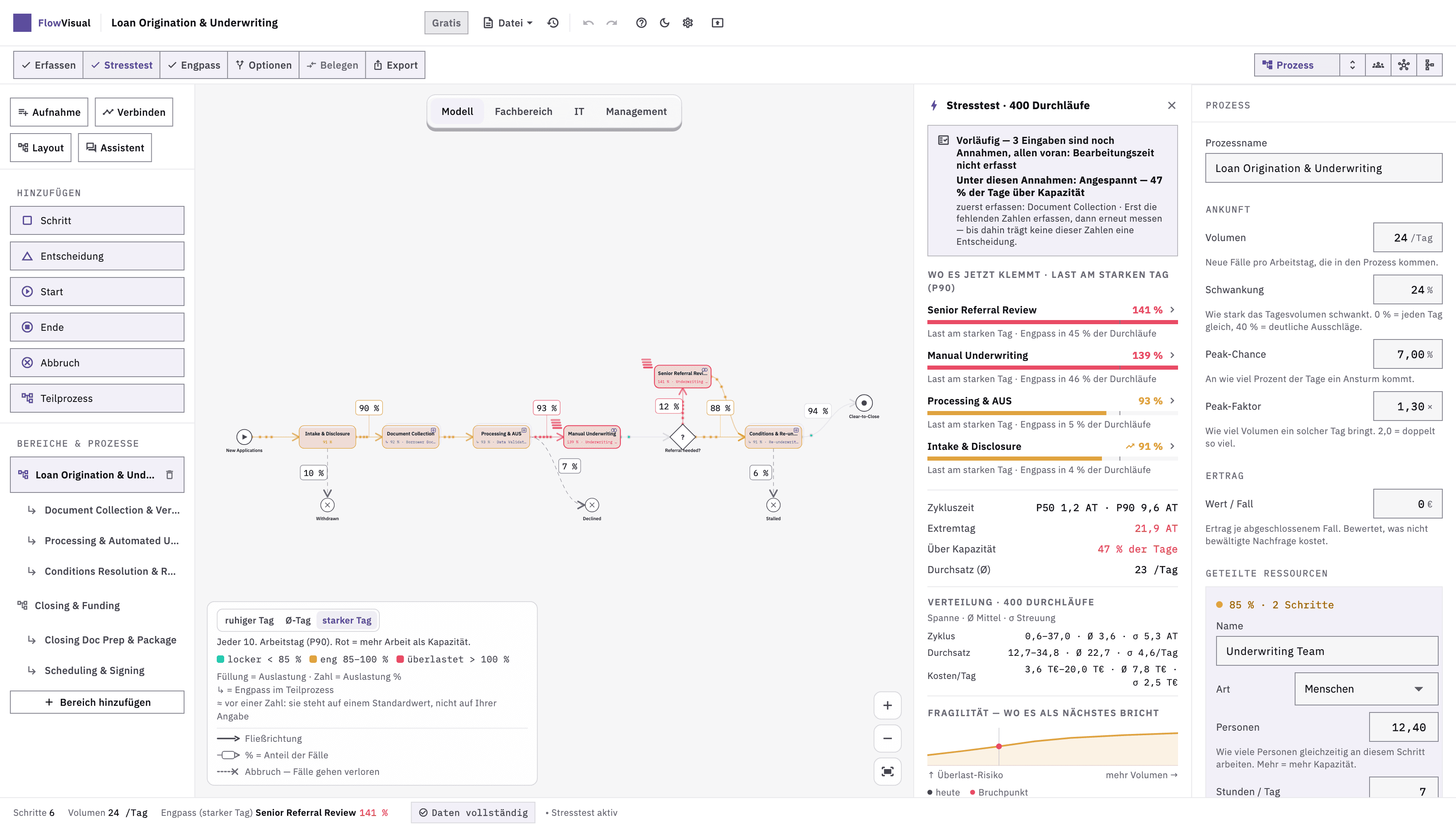
Runs locally, without an account, without a cloud. Text leaves the device only if you explicitly enter your own AI endpoint in the application; without that entry, nothing is transmitted. Material about the software itself — screenshots, version, prices — has its own press kit at flowvisual.app/en/press.
- Platform
- macOS and Windows, version 1.2
- Free
- Modelling, stress test, bottleneck, before/after in euros — no account, no time limit
- Pro
- Save projects and export branded PDFs: 199 € / 399 € / 799 € one-off, or 39 € per month, VAT included
- Data
- runs locally, files stay on your own drive
Jonas Höttler

Founder, Balane GmbH
Jonas Höttler is the founder of Flowrefy. Trained as an industrial clerk, then consulting: CRM migrations for car manufacturers, process workshops, data analysis in Python. Now builds software that simulates processes instead of describing them.
Jonas Höttler is the founder of Balane GmbH in Munich and the author of the FLOWREFY method. His route into processes started with training as an industrial clerk and led through university into consulting, where he ran CRM migrations for car manufacturers, analysed processes in workshops and evaluated data with Python and Power BI. Today he builds tools that quantify a workflow's bottleneck before anyone buys software against it.
Jonas Höttler is the founder of Balane GmbH in Munich and the author of the FLOWREFY method, which measures business processes before money goes into them. His route there started with training as an industrial clerk and led through university into consulting: CRM migrations for car manufacturers, process analysis in workshops, data work with Python and Power BI. The recurring observation: the most effective interventions are usually the simplest ones — you just have to know where to look. That became FlowVisual, a desktop application that simulates a workflow, exposes the bottleneck under load and evidences the improvement in euros. Höttler publishes his sample analyses with their arithmetic and their limits, and advises against acting when a measurement finds no worthwhile lever.
Cleared quotes
These sentences are cleared for use with attribution (Jonas Höttler, founder of Flowrefy). For a quote on your specific angle, an email is enough.
- Mid-sized companies buy software against problems they never measured.
- An average will not reveal the bottleneck. A simulation will.
- References prove nothing about your process. That is why I show none.
- If the measurement finds no worthwhile lever, that is a result — and not an invoice.
- A process is not a sum. The time is created by waiting, not by working.
Subjects I can speak on
Remote or on site, in German or English. Every subject can be shown with a running simulation rather than asserted on slides.
The average fallacy
Talk, 20–45 minutes, with a live simulation
Why an average systematically hides the bottleneck, how queues and variation create lead time, and what that means for investment decisions. The underlying calculation is published and can be recomputed.
Measure first, automate second
Talk, 30 minutes
The eight FLOWREFY steps and the question of why step O (simulate) is almost always skipped in practice — with the consequence that nobody can say whether the automated workflow was expensive to begin with.
Marketing without references
Podcast or conversation, 30–60 minutes
How to make a new offering credible without inventing a success story: published sample analyses instead of case studies, the conditional instead of a headline figure, a refusal instead of a follow-up contract. Including the places where this costs business.
Process simulation on your own laptop
Workshop, 45–90 minutes, participants work along
One process, one bottleneck, one before/after calculation — with FlowVisual, locally, without an account. Every group leaves with a model and a number they can defend.
For multipliers: tax advisors, IT resellers, consulting networks
The method is documented openly and the software runs without an account — both are explicitly meant to be passed on. Anyone advising clients can use the calculators and FlowVisual under their own name without involving us.
There is no exclusivity, no territory agreement and no commission tier that only kicks in at volume. The handover point is simple: you measure with the tool, and when an implementation comes up that you would rather not do yourself, we talk about a fixed price.
For tools in your own layout (letterhead, colours, proposal PDF) there is the FlowVisual Pro licence. What that costs is in the facts table above.
Imagery, logos, documents
One package holds everything: the logo in three variants, the mark on its own, a print-resolution portrait, FlowVisual screenshots, and the boilerplate and fact sheet as plain text.
- Press kit, complete (ZIP)zip
- Pressemappe, 2 pages (PDF, German)pdf
- Press kit, 2 pages (PDF, English)pdf
- One-pager, 1 page (PDF, German)pdf
- One-pager, 1 page (PDF, English)pdf
- Logo for dark surfaces (SVG)svg
- Logo for light backgrounds (SVG)svg
- Mark on its ground (SVG)svg



- Logos, screenshots and the portrait may be used free of charge for reporting on Flowrefy, FlowVisual and Balane GmbH, in print and digitally.
- Credit: Flowrefy / Balane GmbH.
- Please do not alter the logo: no distortion, no recolouring, no effects. Use the light version on dark surfaces and the dark version on light ones. Keep clear space of at least half the height of the mark on all sides.
- The wordmark is set in IBM Plex Mono Medium (SIL Open Font License 1.1). The letters are outlines inside the SVG file, so no installed font is required.
- No right is granted to use the logo in a way that suggests a partnership, a client relationship or an endorsement.
Straight to the person responsible
Enquiries from editors, podcasts and event organisers go to the same address and are usually answered the same working day. For an interview, a proposed slot is enough; questions up front are welcome but not a condition.
- Contact
- Jonas Höttler, founder
- j@hoettler.com
- Address
- Balane GmbH, Balanstrasse 84, 81541 Munich, Germany
- Meeting
- Bookable from the contact page — video call, 30 minutes